

More Than an Acronym: "HRT," "GAHT," and the Language of Trans Hormone Care

Ask a trans person how long they've been on hormones and you'll probably hear some version of "two years on HRT." Ask their endocrinologist, and the chart may say something different: gender-affirming hormone therapy, or GAHT. Both describe the same prescriptions, the same lab work, and the same physical changes.
The gap between those two terms shows how medicine names things, how communities name themselves, and why neither vocabulary is simply "wrong." This article traces where each term came from and why both belong in the history of trans medicine.

Hormones have been part of trans medical care for nearly a century, and for most of that time the vocabulary was borrowed.
Where "Hormone Replacement Therapy" Came From
The phrase "hormone replacement therapy" was built for cisgender bodies, specifically menopausal women. Its modern history begins in 1942, when the U.S. Food and Drug Administration approved Premarin, a mix of estrogens derived from pregnant mares' urine (the name itself is a contraction of PREgnant MARe urINe) [1][2].
The term took off in the 1960s. In 1966, gynecologist Robert A. Wilson published the bestseller Feminine Forever, which framed menopause as an estrogen-deficiency disease that could be "cured" by replacing the missing hormone [1][2]. Within a decade, Premarin had become the fifth-most-prescribed drug in the United States. Decades later, reporting revealed that Wilson's work had been funded by Premarin's manufacturer [2].
The underlying idea was straightforward: the ovaries stop producing hormones, so medicine replaces what was lost. The same logic applied to men with hypogonadism receiving testosterone. "Replacement" implies restoring a baseline the body once had. That fits a postmenopausal woman taking estradiol. It fits less neatly for a trans woman whose body never produced estrogen at feminizing levels, or a trans man starting testosterone for the first time.
Even the cisgender field has moved away from the term. In July 2002, the National Heart, Lung, and Blood Institute stopped the Women's Health Initiative's estrogen-plus-progestin trial early after finding increased risks of invasive breast cancer, heart disease, stroke, and pulmonary embolism [3][4]. The results upended decades of assumptions and much of the marketing built around "HRT."
In the years since, the language around menopausal care has shifted toward "menopausal hormone therapy" (MHT) or simply "hormone therapy." The Menopause Society (formerly the North American Menopause Society) titles its guidance a hormone therapy position statement [5], and Mayo Clinic notes that menopausal hormone therapy "used to be called" hormone replacement therapy [6]. The older term hasn't vanished: the American College of Obstetricians and Gynecologists still lists it as a synonym for patients [7], and it remains common in the UK. But "HRT" is no longer the preferred clinical term for anyone, cis or trans.
How Trans Medicine Named Its Own Treatment
Hormones have been part of trans medical care for nearly a century, and for most of that time the vocabulary was borrowed. In Weimar-era Berlin, Magnus Hirschfeld's Institut für Sexualwissenschaft (Institute for Sexual Science) treated early patients such as Dora (Dorchen) Richter and the Danish artist Lili Elbe in the late 1920s and early 1930s [8]. The institute was destroyed by the Nazis in 1933, and much of that early clinical record was lost.
The next landmark came from Copenhagen. Christine Jorgensen, a U.S. Army veteran from the Bronx, began estrogen treatment under Danish endocrinologist Christian Hamburger, a specialist in hormonal therapy, before a series of surgeries starting in 1951 [8]. She chose the name Christine in his honor. On December 1, 1952, the New York Daily News ran her story on its front page under the headline "Ex-GI Becomes Blonde Beauty," making her an overnight celebrity [8]. Hamburger and colleagues published her case in JAMA in 1953 under the title "Transvestism: Hormonal, Psychiatric, and Surgical Treatment" [9], a reminder of how unsettled the terminology was.
[PHOTO — Figure 1] Christine Jorgensen in 1954. Portrait by Maurice Seymour, Chicago; public domain in the U.S. (published without a copyright notice). View / download on Wikimedia Commons [F1]
In the United States, the central figure was Harry Benjamin, a German-born endocrinologist who had known Hirschfeld in Berlin [10][11]. His background is revealing for the "HRT" story. Before he turned to trans medicine in his sixties, Benjamin ran a Park Avenue practice built on rejuvenation and geriatric hormone treatments for aging patients [10]. The same interwar enthusiasm for "restoring" hormones that later fueled menopausal HRT shaped the first American trans hormone care. His 1966 book The Transsexual Phenomenon argued for hormonal and surgical treatment rather than psychoanalysis, and influenced a generation of patients and clinicians [10][11]. His name later went to the Harry Benjamin International Gender Dysphoria Association, which published the first Standards of Care in 1979 and is now the World Professional Association for Transgender Health (WPATH) [11][12].
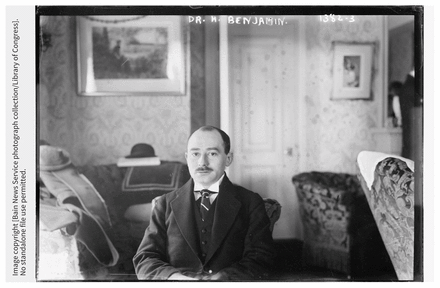
[PHOTO — Figure 2] Harry Benjamin on his arrival in New York, February 1913. Bain News Service photograph collection, Library of Congress Prints and Photographs Division (Bain images carry "no known restrictions on publication"). Reproduced in Li, CMAJ 2023 [10] [F2]
From the 1970s through the 2010s, clinical literature most often called this treatment "cross-sex hormone therapy." The term appeared in major journals well into the last decade; a 2015 Obstetrics & Gynecology study, for example, was titled "Effects of Cross-Sex Hormone Treatment on Transgender Women and Men" [13]. Critics pointed out that "cross-sex" framed treatment as moving to the "opposite" sex, implying a binary that doesn't reflect many patients, including nonbinary people seeking partial or low-dose regimens.
"Gender-affirming hormone therapy" emerged as the replacement. The Endocrine Society's guideline shifted from "Endocrine Treatment of Transsexual Persons" (2009) to "Endocrine Treatment of Gender-Dysphoric/Gender-Incongruent Persons" (2017) [14], and WPATH's Standards of Care, Version 8 (SOC-8, 2022) uses "gender-affirming hormone therapy (GAHT)" in its hormone therapy chapter [12]. Academic centers such as Johns Hopkins now publish patient guidance under the GAHT name [15]. Some guidelines go further: New Zealand's 2023 primary-care guidelines distinguish "E-GAHT" (estrogen-based) from "T-GAHT" (testosterone-based) [16].
The clinical case for GAHT is about accuracy. It describes the treatment's purpose, aligning physical characteristics with gender identity, rather than borrowing a model designed for hormone deficiency. It also separates trans care from menopausal and hypogonadal treatment in records and research. Because doses, monitoring, and goals differ, that distinction matters for data quality and patient safety.
Why the Community Said "HRT" Anyway
Among trans people, "HRT" stuck, and it stuck for reasons that have little to do with endocrinology. Community resources still acknowledge the lineage: Transfeminine Science, a widely used trans-run reference site, notes that its subject was known "more in the past" as male-to-female hormone replacement therapy [17].
1. It was the language available
For much of the twentieth century, "hormone replacement therapy" was the phrase that pharmacists, general practitioners, and the public recognized. Popular accounts of Jorgensen's transition routinely describe her Danish treatment as "hormone replacement therapy" [8]. Trans communities adopted the familiar term as they built their own information networks.
Those networks began on paper. The Digital Transgender Archive (DTA) holds decades of community newsletters in which hormones were a constant topic, from the Metamorphosis publications that Rupert Raj produced for trans men in Toronto between 1982 and 1988 [18] to Gender Euphoria, a San Antonio newsletter digitized from 1987 to 1999 [19]. In San Francisco, Lou Sullivan's guide Information for the Female to Male Crossdresser and Transsexual circulated through correspondence networks during the 1980s, and dozens of related letters survive in his collection at the GLBT Historical Society, searchable through the DTA [20]. Sullivan, a gay trans man, was refused treatment by gender clinics that insisted trans men must be attracted to women, and he spent years helping others reach endocrinologists outside the clinic system [21].


[PHOTO — Figure 3] Lou Sullivan.
When those networks moved online in the 1990s and 2000s, the shorthand moved with them. Long-running forums such as Susan's Place show "HRT" as everyday vocabulary; members' signatures in the 2010s list dates like "HRT 1989–91" and threads celebrate "HRT anniversaries" [22].
2. Access, gatekeeping, and DIY
For decades, formal hormone care was hard to reach. Doctors often set strict eligibility standards, and historians note that mainstream care went mostly to wealthier, white, heterosexual-presenting patients [23]. Researchers define gatekeeping as clinicians controlling who qualifies for hormones, often through mental health assessments and approval letters that pressured patients to tell their stories in a narrow way [24].
Many trans people went around the system. Historian Jules Gill-Peterson has documented how, in the mid-twentieth century, poorer trans people shared hormones with one another, while more affluent community members warned against doing so in newsletters such as Transvestia and Moonshadow [23][25]. That practice is now widely called "DIY HRT," and the term has entered peer-reviewed research: a 2024 Social Science & Medicine study of 36 U.S. participants is titled around "do-it-yourself hormone replacement therapy" [26], and a four-year Stanford study of online DIY-HRT communities found Reddit had become their central hub [27]. The acronym is embedded in this history of self-organized care.
3. "Replacement" can be accurate
Many trans people argue that "replacement" fits. One version holds that the hormones replace ones their bodies should have produced, the ones congruent with who they are. Another is more literal. After an orchiectomy, oophorectomy, or other gonadectomy, a trans person's regimen replaces hormones their body no longer makes, just as it would for a cis person. Clinical guidance supports part of this view: UCSF's gender-affirming care guidelines describe feminizing estrogen therapy as broadly similar to estrogen replacement in people without functioning gonads or after menopause, with some dosing changes [28].
4. A marker of shared experience
"HRT" has grown into more than a medical term. Trans people celebrate "HRT anniversaries" (sometimes called "hormoneversaries"), share timeline photos, and use shorthand like "E" and "T" [22]. The acronym marks a milestone and a shared experience. It carries community memory in a way that a clinician's preferred term, however precise, hasn't yet earned.
Two Vocabularies, Two Jobs
The tension between "HRT" and "GAHT" isn't really a debate about which term is correct. The two terms do different work.
Clinical language aims for precision, consistency across records, and a clear line between treatments with different protocols and risk profiles. By that standard, GAHT is the better term. It names what the treatment is for and keeps trans hormone care distinct from menopausal and hypogonadal care in research and practice [12][15].
Community language aims for recognition, belonging, and continuity with a shared past. By that standard, "HRT" has decades of meaning behind it. It is the word in coming-out stories, in the newsletters and forums where people learned what to ask their doctors, and in the jokes that made a hard process feel less lonely [18][20][22]. Asking trans people to drop it in everyday speech would erase part of that history.
The two can coexist. Clinicians don't need to police patients' vocabulary, and patients don't need to read "GAHT" in their chart as erasure. A provider who writes GAHT in documentation but says "HRT" in the exam room, because that's what the patient says, is doing what good care requires: being precise where precision matters and meeting people where they are. At True U Clinic, we honor the person and the language they choose to define their bodies and care.
Why It Matters
Terms like these are small windows into larger histories. "HRT" began as a marketing-era label for menopausal estrogen [1][2], passed through Harry Benjamin's rejuvenation practice into early trans medicine [10], and was taken up by trans communities who built their own knowledge networks when medicine wasn't serving them [20][23]. They borrowed the language available and made it their own.
The clinical shift toward "GAHT" reflects medicine's slower effort to describe trans care on its own terms rather than as a variation of something designed for other patients [12]. Both belong in the history of trans medicine. One records how the field learned to name what it does. The other records how the people it serves named their own lives.
References
Cagnacci A, Venier M. The controversial history of hormone replacement therapy. Medicina (Kaunas). 2019;55(9):602.
Dominus S. Women have been misled about menopause. The New York Times Magazine. February 1, 2023. See also Robert A. Wilson (gynecologist), Wikipedia.
Fred Hutchinson Cancer Research Center. NHLBI stops trial of combined hormone-replacement therapy. Press release, July 9, 2002.
Sibbald B. US estrogen plus progestin HRT trial stopped due to increased risk of breast cancer, stroke and heart attack. CMAJ. 2002;167(3):294.
The 2022 Hormone Therapy Position Statement of The North American Menopause Society Advisory Panel. The 2022 hormone therapy position statement of The North American Menopause Society. Menopause. 2022;29(7):767–794.
Mayo Clinic Staff. Hormone therapy: Is it right for you? Mayo Clinic.
American College of Obstetricians and Gynecologists. Hormone therapy for menopause. Patient FAQ.
Christine Jorgensen. Wikipedia. (For primary coverage, see the New York Daily News, December 1, 1952, and Jorgensen C. Christine Jorgensen: A Personal Autobiography. Paul S. Eriksson; 1967.)
Hamburger C, Stürup GK, Dahl-Iversen E. Transvestism: hormonal, psychiatric, and surgical treatment. JAMA. 1953;152(5):391–396.
Li A. Harry Benjamin and the birth of transgender medicine. CMAJ. 2023;195(48):E1665.
Harry Benjamin. Encyclopædia Britannica.
Coleman E, Radix AE, Bouman WP, et al. Standards of care for the health of transgender and gender diverse people, version 8. International Journal of Transgender Health. 2022;23(Suppl 1):S1–S259.
Deutsch MB, Bhakri V, Kubicek K. Effects of cross-sex hormone treatment on transgender women and men. Obstetrics & Gynecology. 2015;125(3):605–610.
Hembree WC, Cohen-Kettenis PT, Gooren L, et al. Endocrine treatment of gender-dysphoric/gender-incongruent persons: an Endocrine Society clinical practice guideline. Journal of Clinical Endocrinology & Metabolism. 2017;102(11):3869–3903. (Earlier edition: Hembree WC, et al. Endocrine treatment of transsexual persons. JCEM. 2009;94(9):3132–3154.)
Johns Hopkins Medicine. Gender-affirming hormone therapy (GAHT).
Carroll R, Nicholls R, Carroll RW, et al. Primary care gender affirming hormone therapy initiation guidelines. Professional Association for Transgender Health Aotearoa (PATHA); 2023.
Transfeminine Science. Home page.
Digital Transgender Archive. Metamorphosis collection (Metamorphosis Medical Research Foundation and Rupert Raj, 1982–1988).
Digital Transgender Archive. Home page; featured collection Gender Euphoria (Boulton and Park Society, 1987–1999).
Digital Transgender Archive. Items with subject "Information for the Female to Male Crossdresser and Transsexual", including the Lou Sullivan Collection, GLBT Historical Society.
University of Victoria Transgender Archives. Lou Sullivan (1951–1991). "Word of Mouth" digital exhibit.
Susan's Place forums. Example threads: "One year anniversary of starting HRT" (2015); "My 1st HRT Anniversary!" (2016); HRT anniversary discussion (2018).
The troubled history of DIY trans healthcare. The Nation. May 2026.
Dilemmas in patient-clinician communication about do-it-yourself hormone therapy: a qualitative study. SSM – Qualitative Research in Health. 2022.
Gill-Peterson J. Doctors who? The Baffler. November 2022.
"Not just rebellious, it's revolutionary": Do-it-yourself hormone replacement therapy as liberatory harm reduction. Social Science & Medicine. 2024.
DIY-HRT: do-it-yourself hormone therapy, online community, and grey-market drugs. Stanford Digital Repository.
UCSF Gender Affirming Health Program. Overview of feminizing hormone therapy. Guidelines for the Primary and Gender-Affirming Care of Transgender and Gender Nonbinary People.
Image Credits
Figure
Image
Creator / collection
Rights
Source
F1
Christine Jorgensen, 1954
Maurice Seymour, Chicago
Public domain in the U.S. (published without copyright notice), per Wikimedia Commons
F2
Harry Benjamin arriving in New York, February 1913
Bain News Service photograph collection, Library of Congress
Bain images are generally marked "no known restrictions on publication"; use the Library of Congress original, not the CMAJ reproduction, which prohibits standalone reuse
Li, CMAJ 2023 (figure credit); LoC Bain collection
F3
Lou Sullivan
Making Queer History
Mostly "copyright undetermined"; link, or request permission to reproduce