Puberty Blockers: What They Are and How They Work
You may have heard the term "puberty blockers" in the news, at school, or from your doctor. A lot of what gets said about them is confusing!
Here's a clear explanation of what these medicines are, how they work, and what happens when someone stops taking them. Let's dive in!

To understand blockers, it helps to understand puberty.
What are Puberty Blockers?
"Puberty blocker" is a nickname. These medicines are called GnRH agonists. Doctors sometimes call them GnRHa for short. Some brand names are Lupron Depot-Ped, Supprelin LA, Triptodur, or Fensolvi.[6]
These medicines pause puberty. They put it on hold. They do not change a person into anything. They press pause.
How Do They Work?
To understand blockers, it helps to understand puberty.
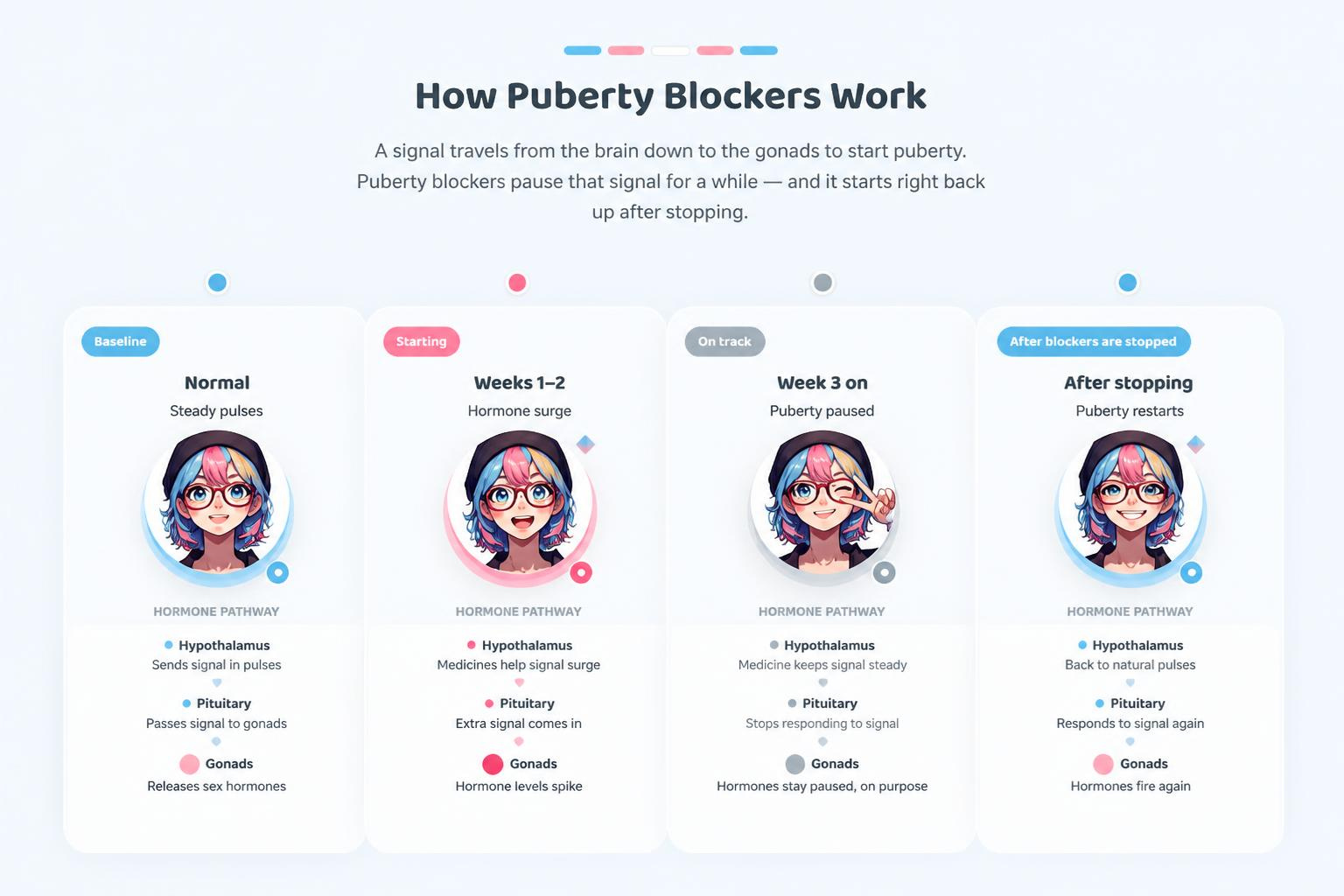
Puberty starts in the brain. A small part of the brain sends out a signal. That signal tells the body to start making sex hormones — such as testosterone or estrogen. Those hormones cause the changes we think of as puberty: a deeper voice, facial hair, breast growth, periods, and more.
GnRH agonists work on those brain signals, slowing down, then stopping the production of estrogen or testosterone temporarily. Puberty pauses.[2]
The key thing to know is this: the medicine does not damage anything. It just pauses the signal that causes puberty to progress. When the medicine stops, the signal comes back.[2][4]
Who Uses Them?
GnRH agonists have been used safely in medicine for more than 30 years. They are used for several different reasons. The FDA has officially approved GnRH agonists for things like early puberty, gynecological health, and certain cancers. Their ability to pause hormone production means doctors also use them "off-label" for specialized gender-affirming care and other reproductive treatments, such as IVF.[6][11]
Early puberty. Some kids start puberty very young — sometimes as young as 5 or 6. Doctors call this central precocious puberty. Blockers pause puberty until the child is closer to a normal age.[6]
Endometriosis and fibroids. Adults sometimes take these medicines to treat pain conditions, or abnormal uterine bleeding.[6][12]
Some cancers. Certain cancers grow faster with sex hormones. Blocking those hormones can help the patient fight their cancer.[6]
Gender dysphoria in teens. Some transgender and gender-diverse teens use blockers to pause puberty while they and their family figure out next steps.[1][2]
Why Would a Teen Pause Puberty?
Puberty is permanent. Once a voice drops, it stays dropped. Once breasts grow, they stay. Some of those changes can only be undone later with surgery, and some can't be undone at all.
For a teen with gender dysphoria, going through the wrong puberty can be very distressing. Blockers give that teen and their family time. Time to talk. Time to work with a therapist. Time to choose which puberty is best, before allowing nature to create changes that are harder to undo.
Groups like WPATH, the Endocrine Society, and the American Academy of Pediatrics describe blockers this way — as a way to buy time, not as a final step.[1][2][3]
Blockers are not given to young children who have not started puberty. Guidelines agree that patients must be showing early physical signs of puberty before blockers are considered.[2][5]
How Are They Given?
There are two main ways:
A shot. Given by a medical provider every 1 to 6 months, depending on the type.[6]
A small implant. A tiny rod placed under the skin of the upper arm. It works for about a year, then gets replaced.[6]
Both are done under the direction of a medical provider. Neither is a daily pill.
What Does the Care Look Like?
Starting blockers is not a quick decision, and it is not a decision a teen makes alone.
Guidelines from WPATH, the Endocrine Society, and children's hospitals like CHOP and UCSF all describe a similar path:[1][2][4][5]
A full assessment, usually including a mental health professional
Parent or guardian consent, plus the teen's own agreement
A talk about what the medicine does and doesn't do
A talk about fertility — before starting, not after
Regular check-ins: height, weight, blood tests, and bone scans
That last part matters. Care doesn't end when the prescription starts. Monitoring is part of the treatment.
Medical providers monitor patients on puberty blockers closely. Here are some of the things they will track while someone is on a puberty blocker:
Bones. Puberty is when bones build most of their strength, and using blockers alone may slow that down. That's why providers check bone density with a scan called a DEXA and suggest calcium, vitamin D, and exercise.[7][8][9]
Height. Growth may slow, but most people catch up. Providers track it at every visit.[2]
Fertility. Blockers alone don't cause permanent infertility. But a teen who goes from blockers straight to estrogen or testosterone, without ever going through their natal puberty, may have fewer options for saving eggs or sperm later. That's why this conversation happens before starting.[2][4]
Long-term. These medicines have a long safety record. Even so, research on teens using them for gender dysphoria is still ongoing. Like all areas of medicine, researchers continue to study these medicines and their effects.[1][7]
What Does a Blocker Feel Like?
The first shot may leave your thigh sore for a day or two. If you get an implant, your arm may be sore for a day or two.
The first few days, you may not notice many changes. For a week or two afterwards, your hormone levels rise before they fall — this is called the "flare." Some people get acne, mood swings, or a first period; some people don't notice anything at all. It can feel like the medicine is doing the opposite of its job. It isn't. This is part of how it works.[6]
After that, most people say the main feeling is nothing happening. Puberty just stops moving. Some notice hot flashes, tiredness, or headaches, but if they happen at all, they usually go away in the first weeks to a month or so.[6]
If you stop the blocker, puberty picks up close to where it left off, usually within a few months to a year.[2][4]
Are the Effects Reversible?
This is the question people ask most.
The short answer: yes, the pause is reversible. When a person stops taking blockers, the brain signal turns back on. Puberty starts up again, usually within a few months to a year. This is well documented — it's the same thing that happens with kids treated for early puberty. These children are on blockers for years. Once it's time, we simply stop the blockers and these youth go through a normal puberty alongside their peers.[2][4][6]
One more thing worth knowing: studies show most young people who start blockers for gender dysphoria go on to start hormone therapy. Blockers are reversible on their own. But they are often a step on a longer path, and it helps if families understand that from day one.[10]
Access Depends on Where You Live
Rules about care for people under 18 have changed a lot in the last few years, and they vary a great deal by state. Major U.S. medical organizations, including the American Academy of Pediatrics and the American Medical Association, support access to this care, but some states restrict it for transgender youth. Others support it, and many even protect access to treatment for gender diverse youth.[3]
If you're a parent or a teen trying to figure out your options, the honest first step is finding out what's legal and available where you live. Our team at True U Clinic can point you in the right direction.
The Bottom Line
Puberty blockers pause puberty. They've been used safely for decades. When the blocker is stopped, puberty starts again.
Deciding if and when to start a puberty blocker is not a decision made quickly, and requires an experienced medical team, parental support, and emotional support.
If you have questions about care options for yourself or your family, we're glad to talk.
This post is for general education. It is not medical advice. Please talk with a qualified provider about your own situation.
References
1. Coleman E, Radix AE, Bouman WP, et al. Standards of Care for the Health of Transgender and Gender Diverse People, Version 8. International Journal of Transgender Health. 2022;23(Suppl 1):S1–S259.
2. Hembree WC, Cohen-Kettenis PT, Gooren L, et al. Endocrine Treatment of Gender-Dysphoric/Gender-Incongruent Persons: An Endocrine Society Clinical Practice Guideline. Journal of Clinical Endocrinology & Metabolism. 2017;102(11):3869–3903.
3. Rafferty J; American Academy of Pediatrics. Ensuring Comprehensive Care and Support for Transgender and Gender-Diverse Children and Adolescents. Pediatrics. 2018;142(4):e20182162. Reaffirmed August 2023.
4. Deutsch MB, ed. Guidelines for the Primary and Gender-Affirming Care of Transgender and Gender Nonbinary People, 2nd ed. UCSF Gender Affirming Health Program; 2016.
5. Fenway Health. Medical Care of Gender Diverse Children and Adolescents. Spring 2019.
6. Wilson TA, et al. Leuprolide. In: StatPearls. Treasure Island, FL: StatPearls Publishing.
7. Schagen SEE, Wouters FM, Cohen-Kettenis PT, Gooren LJ, Hannema SE. Bone Development in Transgender Adolescents Treated With GnRH Analogues and Subsequent Gender-Affirming Hormones. JCEM. 2020;105(12):e4252–e4263.
8. Klink D, Caris M, Heijboer A, van Trotsenburg M, Rotteveel J. Bone mass in young adulthood following gonadotropin-releasing hormone analog treatment and cross-sex hormone treatment in adolescents with gender dysphoria. JCEM. 2015;100(2):E270–E275.
9. Vlot MC, Klink DT, den Heijer M, Blankenstein MA, Rotteveel J, Heijboer AC. Effect of pubertal suppression and cross-sex hormone therapy on bone turnover markers and bone mineral apparent density (BMAD) in transgender adolescents. Bone. 2017;95:11–19.
10. Brik T, Vrouenraets LJJJ, de Vries MC, Hannema SE. Trajectories of Adolescents Treated with Gonadotropin-Releasing Hormone Analogues for Gender Dysphoria. Archives of Sexual Behavior. 2020;49(7):2611–2618.
11. Practice Committee of the American Society for Reproductive Medicine. Prevention of moderate and severe ovarian hyperstimulation syndrome: a guideline (2023). Fertility and Sterility.
12. American College of Obstetricians and Gynecologists. Management of Symptomatic Uterine Leiomyomas: ACOG Practice Bulletin No. 228. Obstetrics & Gynecology. 2021;137(6):e100–e115.